
The advice I wish I’d followed the first time around: The Enneagram of Personality for Beginners!
If I were learning about the Enneagram of Personality in 2026, this is what I would do differently.
I wish I could go back in time to when I first heard the word Enneagram.
I was in my early 20s. My roommate, Adjoa, had a copy of The Wisdom of the Enneagram by Russ Hudson and Don Richard Riso.
If you’re not familiar, it’s basically one of the most comprehensive Enneagram books ever written. And it shows.
That bad boy is a tome. (I recently heard Russ Hudson say on a podcast that the original manuscript was almost 2x as long!!)
Adjoa had it highlighted, underlined, and annotated within an inch of its life.
I was immediately triggered.
All I could think about were college courses that made me want to rip my hair out.
She started telling me about her type, her boyfriend’s type, and how she was pretty sure I was a Type Eight. She read me the description, and I recoiled.
Not only did it not resonate, but I felt completely overwhelmed.
Levels of development. Centers of Intelligence. Disintegration. Integration. 🫤
Sounded like a psychology course that I definitely did not have the prerequisites for.
So I smiled, nodded, and silently vowed never to bring it up again.
And I didn’t think about the Enneagram for three whole years.
Three more years of not understanding why my sense of worth hinged on whether my parents were proud of me.
Three more years of working myself straight into burnout.
Three more years of being painfully unaware of why I was doing the things I was doing.
7 Steps to Understanding the Enneagram of Personality (knowing what I know now)
So here’s what I would do differently if I were hearing the word Enneagram for the very first time in 2026.
First, I’d tell myself this:
Yes, it might sound a little woo-woo.
But don’t check out. This is going to change your life.
I’d also say:
I know the books look intense. You’ll eventually get to a place where the depth feels fascinating instead of overwhelming. Where it actually gives you clarity about who you are as a human being.
But for now, you don’t need to know everything.
You just need a starting point.
Here are the seven steps I would follow.
Step 1: Do not, under any circumstances, go onto Instagram
Or TikTok. Or Reddit. Or any social platform where people are casually joking about the Enneagram.
There is a time and place for memes and skits. Honestly, that’s how I grew my social media following in the first place.
But if you’re brand new, you don’t yet know how to filter things like:
“This is a stereotype.”
“This is oversimplified.”
“There’s way more nuance than this.”
You don’t want to end up typing yourself based on coffee orders.
“I like London Fogs… this account said I’m a Type Four.”
Instead, pick one solid source and learn from that. Sit down with it. Make some tea. Read about the basics and all nine types.
That’s how I eventually found my type, once I got over myself and actually gave the Enneagram a real shot.
Step 2: Get a book that matches how you learn
If possible, choose a book that includes a reflective or journaling component. Prompts. Exercises. Space to process.
Because learning about the nine types, the stress and growth arrows, and the centers of intelligence is important, yes. But it’s only half the work.
The real change comes when you translate that knowledge into your actual life.
Otherwise, what’s the point?
Your type shouldn’t be a fun fact you drop at happy hour.
It should make your life better.
That was my goal when I wrote My Enneagram: A Visual Guide to Find Your Personality Type, Stress Less, and Live Your Dreams.
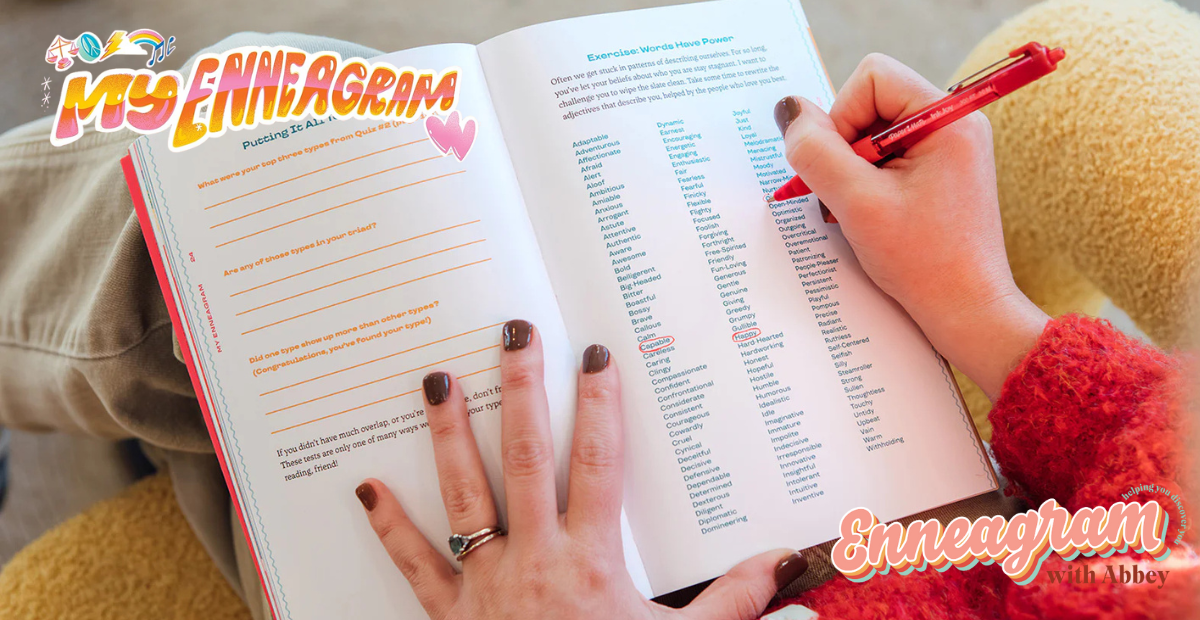
It’s officially available now. It’s the book I wish I’d had when I first heard the word Enneagram.
You can find it on Amazon, Barnes & Noble, Target, and pretty much anywhere books are sold. 😊
Step 3: Focus on motivation, not behavior
My sister and I both went to a four-year university.
Same behavior.
Completely different motivations.
I’m a 3w4. I wanted the best theater program possible so I could pursue my lifelong goal of becoming a professional actor.
My sister is a 6w7. Her goal was security. Get a degree. Get a job. The specifics didn’t matter as much as knowing she’d be taken care of afterward. If she could join a sorority and have some fun too, even better.
A lot of personality typing systems are behavior-based. You do X, therefore you are Y.
The Enneagram asks a different question: Why are you doing X?
That’s why types like Twos and Nines are so often mistyped. They can look similar on the outside—helpful, accommodating, self-sacrificing—but internally they’re coming from very different places.
If you’re only looking at the surface behavior, you’ll get your type wrong… and, more importantly, miss a real opportunity for growth.
Step 4: Tone down the judgment
There are no “good” or “bad” numbers.
Yes, discomfort is part of the process. Seeing your blind spots can make you cringe. That’s normal. (In fact, that’s usually a sign you’ve found your type!)
But it’s never an excuse to label other people as “healthy” or “unhealthy.”
There are positive and negative aspects to all nine types! Growth comes from holding yourself and others with compassion, remembering that everyone is capable of becoming a healthier version of themselves.
Step 5: Resist typing other people (I know it’s tempting)
This is a rite of passage, so don’t beat yourself up.
I once made my poor dad take an Enneagram test three separate times because I didn’t believe his result. (Sorry, Dad!!)
The issue isn’t being curious. That’s totally okay!!
But when you type someone without their input, you’re prioritizing your interpretation of their behavior over their internal experience.
Going back to step #3. That’s behavior-based typing.
But that doesn’t mean you can’t notice patterns. You can absolutely use Enneagram insight to communicate better, set expectations, and navigate relationships with more empathy.
Just don’t assume you know someone better than they know themselves.
They’ve gotta go on this journey themselves.
Step 6: Chill TF out
As much as I love the Enneagram, it’s still a tool.
It can’t fully capture the complexity of your brain or your soul. It was created by imperfect humans. Personality typing isn’t hard science.
In fact, the Big Five is the only model considered scientifically rigorous.
So please don’t treat the Enneagram like an end-all-be-all authority on who you are allowed to be.
If it helps, use it.
If it doesn’t, be like *NSYNC and say, “Bye bye bye.”
Step 7: Remember… you’re not alone
That thing you’ve struggled with your entire life?
It’s not a personal failure.
Type Ones, you’re not the only ones wrestling with an inner critic.
Type Threes, you’re not the only ones learning how to separate worth from achievement.
Type Eights, you’re not the only ones who’ve been told you’re “too much.”
There is an entire community of people who share your fears, your desires, and your patterns.
And that, more than anything, is what made me feel seen all those years ago when I finally gave the Enneagram a chance.


