
Let’s go beyond the stereotype and examine fear, trust, and what actually drives the Enneagram Type 6.
Introduction to Enneagram Type Six
If I murdered someone, I know exactly who I’d want helping me bury the body:
My Type Six best friend.
I’ve known she had my back since we were kids, playing “Pippi Longstocking” on the playground.(A game we invented that involved climbing the tallest thing we could find and singing this absolute banger at the top of our lungs.)
Even then, she was ride-or-die. Sixes are often called “The Loyalist” for that reason. They tend to be loyal and trustworthy. I say “tend to” because there’s another side of Type Six that’s just as relevant.
There is a side that scans every relationship and situation for potential danger. For many Sixes, trust, whether in themselves or in other people, doesn’t come easily. It must be earned. And if it’s broken?
Kiss that relationship goodbye.
At their core, Enneagram 6s crave support and security. So they work relentlessly to make sure those things aren’t threatened. They notice patterns, imagineworst-case scenarios, and mentally run through problems before they happen.
But I don’t want you to get the wrong idea that Sixes are ALL anxiety and no fun.
The Sixes in my life are probably the funniest people I know.
Maybe it’s because when you’re attuned to what could go wrong, you develop a sharp sense of irony, light, and wit.
Bottom line: Sixes are more than the “worrying” stereotype. To truly understand them, you must examine their core motivations.
Let’s dig into it.
Core Motivations of the Enneagram Type 6
The Core Motivations, or as I like to call them, The Core Four, are the deeper “whys” behind your decisions and behaviors. Two people can each do the same thing on the outside, yet be driven by completely different reasons on the inside. (Here’s a good story on why motivations are so important for self-awareness!)
That underlying reason is what sets us apart.
Take procrastination. We all do it, regardless of type. But the motivation behind it isn’t the same.
For Sixes, procrastination is less about poor time management and more about self-protection.
“If I don’t open the email, the bad news doesn’t exist. Right? Right??”
These motivations fall into four categories:
- Core Desire — “If I get this, I’ll be fulfilled.”
- Core Fear — “If this happens, I’m doomed.”
- Core Weakness — “This is the thing I wish I didn’t struggle with.”
- Soul Message — “This is what I need to hear to feel whole.”
The Core Four of the Enneagram 6
Core Desire: Having security, guidance, and support
Core Fear: Losing support and stability, be it financial, emotional, or relational
Core Weakness: Anxiety—Worrying about the past, present, and future; constantly anticipating worst-case scenarios
Soul Message: “All will be well.”
At a Glance… Sixes Are:
- Sometimes called the Loyalist or the Guardian
- Responsible and methodical
- Uncomfortable with change
- Don’t trust people until trust is earned
- Guided by mental analysis (over their gut instincts or heart)
- Troubleshooters
Enneagram 6 Wings
6w5
The Defender: They are resourceful team players who value security and knowledge. They tend to be more introverted and cautious, with an ability to make reasonable decisions and sound judgments. Both types want their boundaries honored, and can be suspicious of things outside their comfort zone. Leaning into their Five wing, they can back away from confrontation, withdrawing, instead of dealing with the issue.
6w4
The Buddy: They are optimistic explorers who embrace fun. This is a strange mix because while they are spontaneous and playful, they also have a strong need for safety and security. They have a Six’s fear of pain combined with a Seven’s avoidance of pain.
A Note on Subtypes and Type 6s
Sixes are the most commonly mistyped Enneagram type, and subtypes are a big reason why.
Self-preservation, social, and sexual Sixes can look wildly different on the surface, even though they’re driven by the same core issue: fear.
What changes isn’t the motivation, but the coping strategy.
- Sexual Sixes cope with fear by charging straight into it. They confront, challenge, and test with strength, which is why they often get mistaken for Type Eight.
- Social Sixes cope with fear by clinging to rules, systems, or ideologies that promise stability. This can make them resemble Type Ones.
- Self-Preservation Sixes cope with fear by seeking safety through protectors and allies, which is why they’re sometimes mistyped as Type Twos.
Want to go deeper?
→ Beginner’s guide to subtypes
→ In-depth analysis of the Type Six subtypes
The Arrows of the Enneagram
Let’s talk about how your personality shifts based on your state of health.
Here’s what sets the Enneagram apart from most personality systems:
It doesn’t put you in a box.
It shows movement: how you grow, how you react under pressure, and how you evolve.
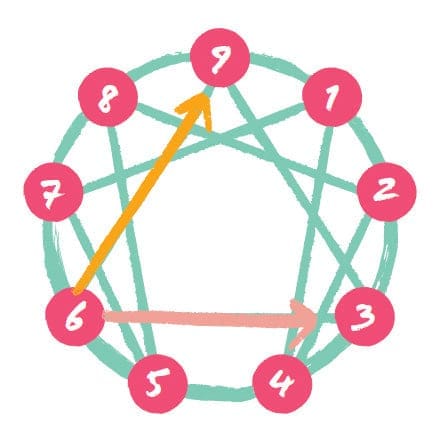
Each type connects to two others via “arrows” or paths. But really, four paths reflect how your personality shifts:
Growth Path — Your best self
Stress Path — When you’re overwhelmed
Blind Spot Path — When you’re with people you trust enough to let your guard down and show the “messy” sides of yourself.
Converging Path — Deep transformation
Let’s break those down. ⬇️
Growth Path: Balanced like a balance beam, baby!
When a Six is growing, they move toward the high side of a Type Nine. Your nervous system settles. Your thoughts slow down. You’re able to stay present instead of constantly scanning for what might go wrong.
Trust comes more easily, not because the world suddenly feels safer (I wish 🙄). But because you trust your own inner guidance. You rely less on external validation and more on your internal sense of “I’ve got this.”
Stress Path: When it rains, it pours
Under stress, a Six moves towards the low side of a Type Three. You keep busy to avoid addressing any icky feelings under the surface. Image starts to matter more. Like you replay conversations over and over — overanalyzing how you came across and how you compare to others.
That comparison loop can leave you feeling both insecure and oddly competitive at the same time.
Blind Spot Path: Safety that turns into stagnation
When you’re around people who make you feel secure, you may move towards the low side of a Type Nine.
Yep, you can access the good and bad parts of both your arrows!
You might shut down under stress, numb out instead of engaging, or become quietly passive-aggressive when your needs aren’t met. Comfort becomes more important than growth. “Let’s just stay on the couch, eating Cheetos and watching Gilmore Girls reruns, where it’s safe.”
Converging Path: Healthy 3 energy
As Sixes mature, they can consciously integrate the healthy traits of Type Three. You stay connected to your authentic self while also becoming more focused, decisive, and goal-oriented.
You’re able to go after what you want without proving yourself or performing for approval.
The key here is TRUST.
Trusting yourself to act, take risks, and move forward without letting fear run the show.
Enneagram IFL (in fictional life): Type Six
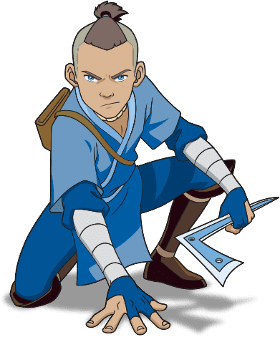
Sokka, Avatar: The Last Airbender
Loyalty is key
Sokka is a clear example of an Enneagram Six, and his loyalty is the giveaway. From the beginning of the series, Sokka commits himself fully to his family and to Aang’s mission.
Okay, maybe he will take a little convincing 😂 But once he’s in, he’s LOCKED in. He trains, plans, studies, and strategizes, pouring his energy into defeating the Fire Nation and keeping his people safe.
Security and support are also important
At his core, Sokka wants security and support. That motivation makes sense when you look at his childhood. He lost his mother at a young age, and his father left to fight in the war, placing Sokka in the role of protector long before he was ready. As the oldest remaining male in his village, responsibility landed on him fast, and he took it seriously.
Because Sokka has already lived through worst-case scenarios, he expects them. Like many Sixes, his mind is constantly running contingency plans.
Preparation becomes a way of life
As a result, this is why Sokka thrives as a strategist. His greatest contribution to Team Avatar isn’t bending, it’s his ability to anticipate problems and design creative solutions (and his mean boomerang skills, obviously). We see this clearly during moments like the Day of Black Sun, where his planning and foresight are essential in battle.
When healthy and when out of alignment
I think that Sokka is at his healthiest when he leans into leadership and collaboration. Basically, using his sharp mind for something bigger than himself. I mean, he’s a freaking teenager planning battle tactics against the Fire Nation. It’s impressive!
When Sokka is out of alignment, though, his Six-ish suspicion takes over. He becomes overly distrustful, doubts both himself and others, and scans constantly for danger.
Under stress, Sixes move toward the low side of Type Three, and we see this show up as arrogance and image-protection. A clear example is when Sokka first meets Suki. He assumes he’s superior, dismissing her abilities because she’s a girl, and clinging to the belief that only he can assess threats correctly.
Ultimately, Sokka grows into a much more grounded and secure Six. He learns to trust his own judgment without needing to dominate or prove himself. He allows himself to enjoy his accomplishments, take pride in his leadership, and act bravely without being ruled by anxiety.
One More Thing…
My Enneagram, a guided visual journal to help you find your personality type, stress less, and live your dreams, is officially available to purchase!! It’s available at Barnes & Noble, Target, Walmart, and here on Amazon.


