
For those who think they have to do it all alone: type-specific Enneagram self-care advice for how to get the kind of support you need. ♥️
TL;DR (for the sleep‑deprived among us)
- Postpartum shattered my old definition of self‑care
- I realized self‑care often requires other people
- Asking for help is the biggest barrier, and it shows up differently for each Enneagram type
- Below: type‑specific tips for how to ask for support when you’re depleted
What Postpartum Taught Me About Real Self‑Care
My mom hands me a stack of chocolate espresso cookies, the ones I remember from childhood. Nutty, rich, with a layer of thin chocolate icing on top. Then, a glass of red wine. She lights a candle, closes the door, and I’m alone in the bath at my parents’ house.
(For reference, here’s the five-star, resort-level bathtub we’re talking about ⬇️)
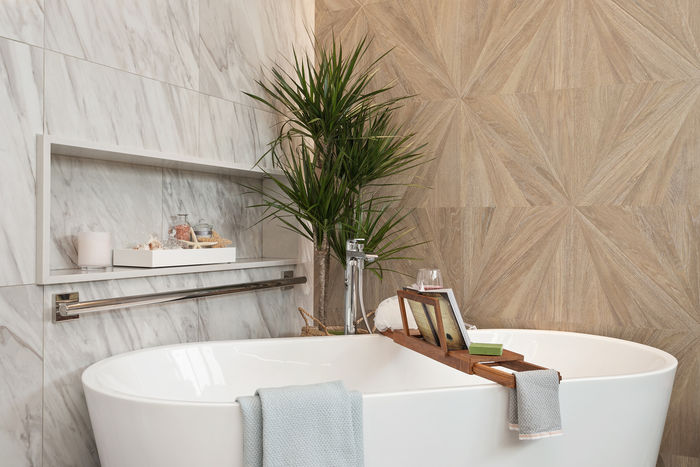
It’s giving self-care bingo, right?
Dreamy bathtub with an array of sweet-smelling oils and salts? Check.
Indulgent snacks and beverages? Check.
Time alone to read the next book in my all-time favorite Emily Wilde series, which just came in the mail? Check!
All awesome. Yay!
But here’s the context: I was two months postpartum, and this was the first time I’d been alone since giving birth to my son.
The Brutal Reality of the Newborn Trenches
They tell you it’s gonna be hard. But no amount of words can prepare you for the newborn trenches.
Brutally confronted with the death of my former self, in constant pain, still bleeding, unable to sit or walk comfortably, nursing, hallucinating from sleep deprivation, consumed by intrusive thoughts, wracked with anxiety about my baby — and the hormone drop??? Don’t even get me started. It felt like I was in hell.
I had never felt what it was like to be completely, utterly depleted.
The Moment I Finally Felt Like Myself Again
So this moment in the bathtub?
Felt like finally eating after weeks of fasting.
I was wrapped in love by my mom, by the stillness, by the sudsy water.
It was just me again.
Hi, me!! I missed you.
When the door clicked shut, when I bit into one of those cookies, took my first sip of wine in 11 months, and cracked the spine on a fantasy novel to whisk me away somewhere clever and whimsical…
It was one of the most pleasurable moments of my life.
The Expert Who Wasn’t Actually Practicing Self‑Care
And I laughed to myself. Because this was self-care.
And I’ve been teaching about self-care and the Enneagram for years.
I’ve got videos, blog posts, Instagram collabs. Heck, I was once flown out to Texas to teach an Enneagram workshop specifically for burned-out public school counselors. Four hours of exercises, breakout groups, slides… all about how to take care of yourself.
So I’m an expert, right??
In theory, I was an expert. In practice? Not at all.
I’ve spent years teaching the Enneagram, and even in my newly published journal, My Enneagram, which maps out each type’s stress responses and support needs — but nothing prepared me for how different it feels when you’re the one who’s completely depleted.
Why Self‑Care Isn’t Something You Can Do Alone
Because what I very quickly learned the minute I became a mom …
I had never felt what it was like to be completely, utterly depleted…
So I had no clue how to fill myself back up.
And honestly?
I don’t think I could have.
Because I needed other people to do it.
The People Who Helped Me
First, my husband (a Type Four), who was in the other room with the baby monitor, ready to be on duty if our son woke up, giving me that space to just breathe.
Then, my mom (a Type Eight) who drew the bath, baked the cookies, poured the wine, and even suggested I take a bath.
My dad (type TBD, but probably a Three or Six), who worked his whole life to afford the beautiful bathroom I was enjoying for free.
And I want to note: I’m writing this 7 months postpartum, and things are night-and-day different. (To any new moms reading this: it does get better!!!)
Why This Matters More Than Ever
Self‑care isn’t bubble baths and candles. It’s the courage to let people support you when you’re at your lowest. And each Enneagram type struggles with that in a different way.
What My Community Told Me About Asking for Help
So I thought I’d take a stab at looking at the Enneagram and self-care through a new lens, one that requires other people to work.
For the times when you’ve reached rock bottom and you just need a little help taking care of yourself.
I asked my Instagram community: What do you do when you need others to practice your self-care?
The responses… made me really sad.
Because so many of the answers looked like this:
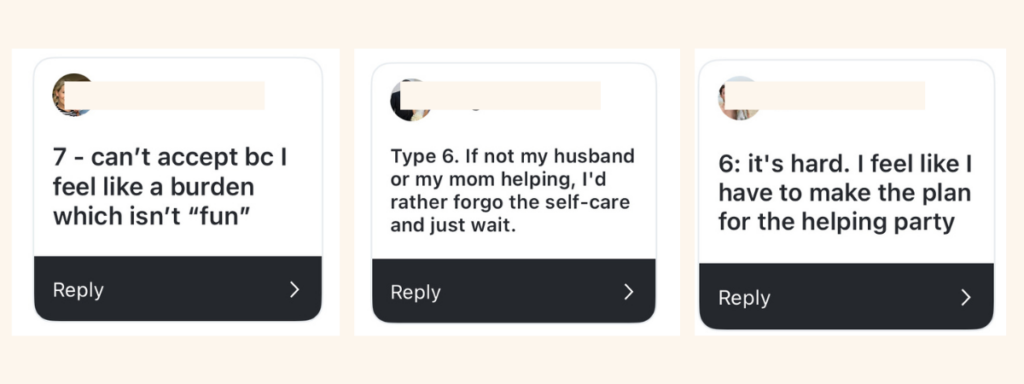
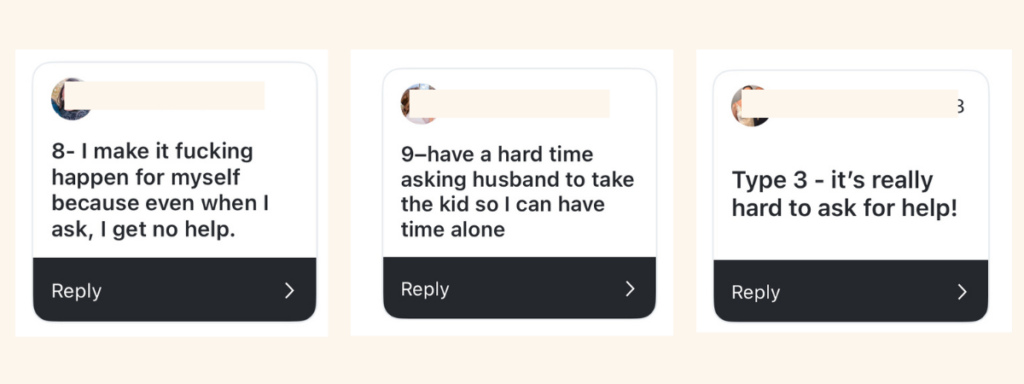
And maybe this is why saying “just practice self-care” doesn’t work.
Even with allllllll the specialized tips for each type.
Because SO much of self-care (especially if you’re a parent) requires an act of service from someone else.
Myths About Asking for Help
Myth #1: Asking for help is a burden.
Truth: People feel honored when you trust them.
Myth #2: If I were stronger, I wouldn’t need help.
Truth: Strength is knowing when you’re at capacity.
Myth #3: Other people have it worse.
Truth: Pain isn’t a competition.
Why Asking for Help Is So Hard (By Enneagram Type)
A One said she can’t enjoy the help when she gets it, so she doesn’t bother asking in the first place.
A Four said they send a highly cryptic text message and hope others magically understand they’re needed. (Don’t recommend this, haha.)
A Five had a similar psychic wish: wanting someone to just notice or check in without having to ask.
A Three said they either find a way around it or they do not practice self-care at all. (That had been my strategy up until baby. Womp womp.)
What Eights Taught Me About Receiving Help
Ironically, Eights were the ones who gave the most helpful advice. (I say ironically because, in my opinion, Eights are one of the types that struggle a lot with this problem.)
But I did notice that most were mature Eights who have had time to live and learn. Also, they were all women… so take that as you will.
(Side note: if you’re a male Eight reading this, drop your tips, story, or struggle in the comments. We want to hear from you.)
One Eight (Hi Lyndrid!) recommends that we build community. She said, “My synagogue Shabbat group knows each other! Helping AND receiving help is a mitzvah in Judaism!”
Another Eight, Gwendolyn, echoed this and added, “When you ask for help, you give someone the opportunity to make a difference. And that makes people feel really good. So you’re not just taking something, you’re giving something too.”
And sometimes, there are times in your life when you’re forced to ask.
Like Cindy, another Type Eight, who was undergoing cancer treatment and had no other option but to lean on others. So they had two “teams” of eight people who alternated care. (Also, her story is so interesting. I’m hoping she’ll share more of her journey with us in a podcast episode.)
How Each Enneagram Type Can Ask for Support
Below are your type‑specific tips with micro‑examples.
Type One: Permission to Rest
You need reassurance that you are allowed to relax and unwind. Reminders from yourself or others that you’re not lazy or “bad” for resting. (Please, Ones, internalize this. You deserve it.)
Try this: Ask someone to take over one task without checking how they do it.
Type Two: Ask a Therapist to Help You Ask
Many Twos find it helpful to see a therapist — someone who can help you figure out what you even want to ask for. That neutral party is key to being able to accept what you need to hear.
Try this: Practice saying, “I could use help with…” in therapy first.
Type Three: Efficiency = Asking for Help
What if I told you it’s more efficient and productive to ask for help? Can it add fuel to your fire and recharge you in a way you couldn’t achieve alone? Wouldn’t you jump on that productivity hack?
Try this: Delegate one task this week and notice how much energy it frees.
Type Four: Use Words, Not Vibes
Get together with a trusted friend for a vent and advice session. And don’t expect your friends to have psychic mind-reading powers, please.
Try this: Text a friend, “I’m overwhelmed and could use company or a check‑in.”
Type Five: Don’t Withdraw — Reach Out
Sometimes, self-care means not withdrawing. Connection is part of your self‑care. Yes, it’s hard!! But it’s so impactful for your overall well-being.
Try this: Ask one friend to hang out — even if it feels uncomfortable.
Type Six: Ask How It Feels to Be Asked
Ask your friends what it feels like when you ask for help. You might be surprised by the answers. People want to feel needed. People want to help. Flip it: How does it feel when you’re asked for help? Does it feel like a burden? I doubt it.
Try this: Ask a friend, “Does it feel like a burden when I ask for help?”
Type Seven: Ask Without Shame
Ask without shame. When others ask you for help, you do it joyfully, right? Let that be true for your village too.
Try this: Ask someone to take something off your plate this week.
Type Eight: Build Community
You cannot do everything alone, and it’s not generous to deprive others of the chance to show up for you.
Try this: Identify two people you trust and tell them what support looks like for you.
Type Nine: Create a Support Roster
Your voice matters. Don’t be afraid to use your voice, Nines. It’s a sign of growth!
Try this: Ask a friend for a walk‑and‑talk and spill your guts.
A New Definition of Self‑Care for Enneagram Types
So, where does that leave us, poor burned-out souls?
What’s an Ennea-nerd to do? After looking at the responses and comparing my own experiences, I concluded that the biggest barrier to getting that help was asking.
Self‑care isn’t something you do alone! It’s something you allow others to do with you.
Further Resources
- My Enneagram — a visual journal to guide you in learning your type’s motivations, stress patterns, and support needs
- Instagram: @enneagramwithabbey
- How Each Enneagram Type Can Practice Real Self-Care (A Guide to Enneagram Self-Love)
- Perfect Gifts for Mom according to her Enneagram type
- Related:


